
Biofeedback for children and teens
Your child can’t calm down on command. Nobody can. But they can learn it.
Biofeedback turns calming down into a game. Sensors on the fingers, a story on the screen. The calmer the body, the further the game goes. Kids who won’t talk to a therapist will happily play.
- Meltdowns and anger outbursts
- Anxiety: school, tests, new places, separation
- Freezing at the board, shyness
- Focus and ADHD: homework, sitting still
- Sleep: falling asleep, waking at night, nightmares
- Stomachaches and headaches from stress
- Stuttering, tics, nail biting
- Explosions when screen time ends
- Sensitivity: noise, light, crowds, tags on clothes
- Overload: too much noise and screens, too many tasks, tests and activities
- Big changes: new school, a move, divorce, a new country
- Teens: exam pressure, panic, burnout
- Puberty swings: hormones, mood up and down
André Fleshel, MA in Applied Psychology, hypnotherapist, trauma-informed coach. 26 years in psychotherapy, in Ukraine and the USA. In Pennsylvania behavioral health programs I used biofeedback with more than forty children and teenagers aged 4 to 19.

Sounds familiar?
- Small things turn into explosions. Tears, shouting, slammed doors, and after it he can’t explain what happened.
- Stomachache every school morning. The doctor says he’s healthy.
- She knows the answer but freezes when the teacher calls her to the board.
- He can’t sit still, can’t finish homework, and you’ve heard “he could do better if he tried” a hundred times.
- Bedtime takes two hours. Then nightmares.
- Stuttering, tics, nail biting that get worse when she’s nervous.
- You suggested a psychologist and got “I’m not crazy” and a closed door.
Behind all of this there is often the same thing: a nervous system that switches into alarm too fast and doesn’t know the way back. Telling a child “calm down” doesn’t work. They don’t know how. Their body has never been shown.
How biofeedback helps
Sensors read heart rate variability (HRV) and skin conductance, the same signals a lie detector uses. The computer turns them into a game: a ball rises when the body relaxes, colors change from yellow to green to blue, a landscape comes to life. Tense up, and it stops.

Nobody lectures. The child tries something with breath and attention, and the screen answers honestly. A child who can’t explain what he feels suddenly sees it. And sees that he can change it.
- It’s a game, not therapy. It gets around the usual barrier: the therapist as a stranger “coming into the family”. Kids want to come back.
- No talking required at the start. Good for kids who shut down, for teens who roll their eyes, for kids on the autism spectrum.
- Fairy-tale language. The stories in the programs carry basic metaphors of growing up. Children learn about themselves through the plot, without a lecture.
- The skill goes with them. To class, to the board, to bed. In my clinical work kids with biofeedback learned to balance emotions and took in psychological ideas noticeably faster than kids without it. I often saw sleep and appetite improve.
- Parents learn it too. A calm parent next to an upset child is half the work.
Ask a question · Book a demo session · $49 · Text: +1 (267) 281 4404

Working with the symptom itself
Biofeedback is not only relaxation. Once a child can hold a calm state, I use it to go straight at the symptom: we bring up the trigger gently, in imagination, while the body stays calm. Little by little the trigger loses its power.
A case: stuttering, three sessions
A seven-year-old boy who stuttered when he got nervous.
- First session. We talked and found the triggers. I taught him to hold his HRV high and steady.
- Second session. We made the skill solid, and I started gentle exposure. He imagined the trigger. Every time his HRV dropped I distracted him and brought him back to restoring it, slowing everything down with music and a beautiful picture on the screen, a blue butterfly. Step by step I returned him to the trigger, until in the game he could replay the whole scene, with sounds, pictures and feelings, while his HRV stayed high.
- Third session. He did everything with confidence and asked about the advanced levels of the program.
Then he told his mom he had decided not to worry anymore. His trigger was the moment when the teacher is about to call someone to the board. I checked in three months later. The result held.
One case is one case, not a guarantee. Every child is different, and stuttering has many causes. But this is what working with the nervous system, not around it, can look like.
What research says
- A systematic review in the Journal of Child Psychology and Psychiatry (Dormal et al., 2021) found that HRV biofeedback reduced physical and mental health symptoms in children and adolescents and improved well-being, especially in anxiety, and recommended it alongside behavioral and cognitive approaches.
- A 2023 meta-analysis of biofeedback in pediatric populations found that EEG, muscle and HRV biofeedback reduced children’s anxiety.
- At Boston Children’s Hospital, kids in anger-control therapy who also played a heart-rate biofeedback game got better at controlling anger than kids who had therapy alone (randomized pilot, Ducharme et al., 2012).
- Biofeedback is non-invasive, with no medication and no known side effects.
The studies are still small, and researchers call for larger trials. That is honest science. My own conclusions come from clinical observation, not controlled research.
At our center
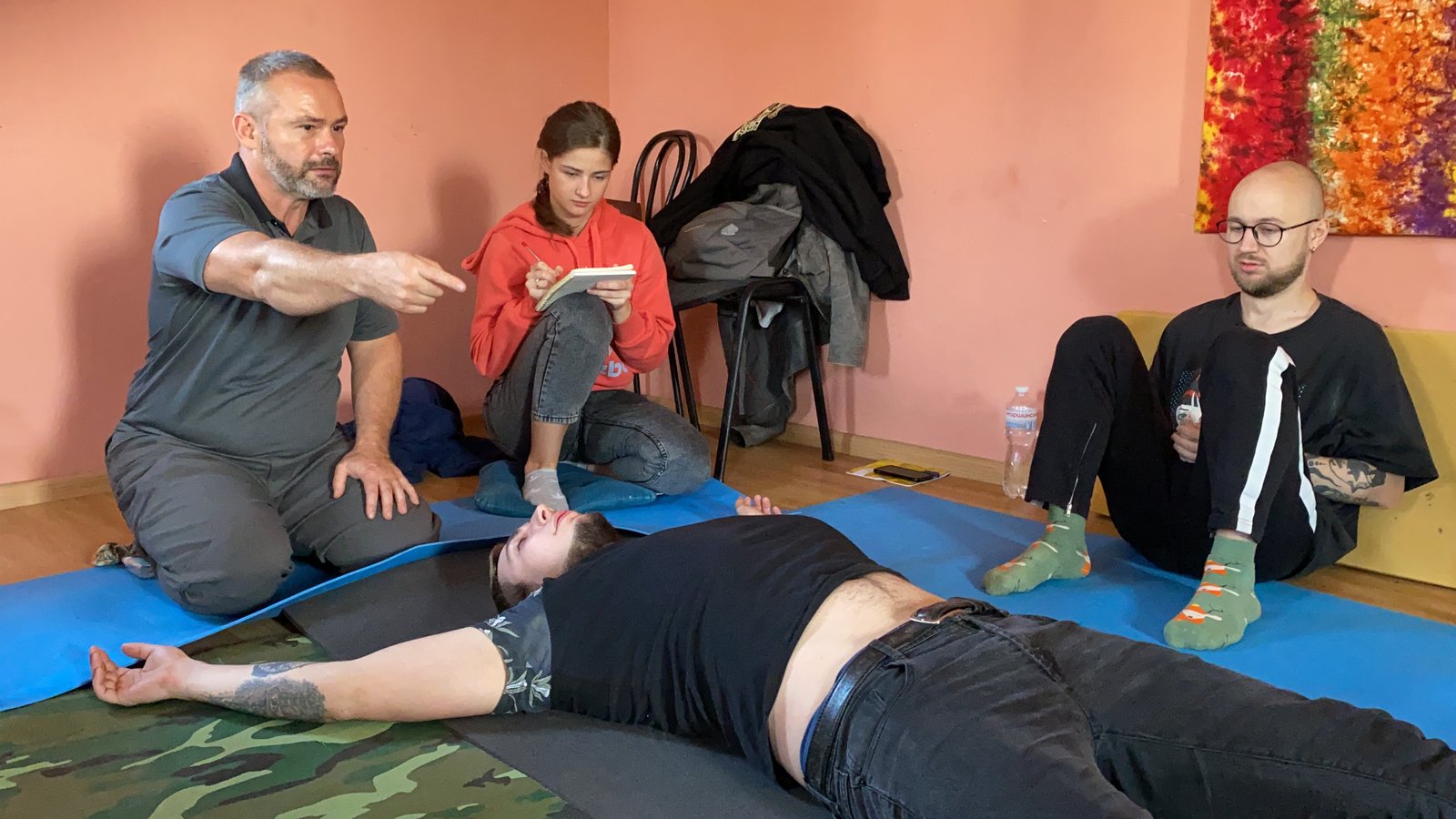
Not a clinic with white walls. Hammocks, handpans, mats, play. Kids come back because they want to.
How it goes
- Demo session, 60 min, $49. A parent comes too. We talk about what’s going on, put the sensors on, see the baseline and play. You’ll see how your child reacts.
- Training sessions, $75/hour, usually weekly. How many depends on the child. The boy above needed three.
- Home practice. 5–10 minutes a day: breathing, a simple exercise, sometimes a small temperature biodot that shows calm by color.

In person at our center in Huntingdon Valley, PA. I’ve worked with children from 4 and teens up to 19; for the youngest we talk with the parents first.
This is self-regulation training, not mental health treatment, and it doesn’t replace medical care. If your child has a mental health diagnosis or is seeing a doctor or therapist, please tell us when you book. The training can go alongside their treatment.
More
Biofeedback training is a self-regulation method. It does not replace medical or psychiatric diagnosis and treatment, and it is not a substitute for speech therapy. If your child has a heart condition, epilepsy or another serious medical condition, talk to your pediatrician first.
